Home / Categories / Courses & memberships
What happens to a student's access when their payment fails?
Nothing happens to a student's access at the moment the payment fails. Access is granted when the order is created, even if the first payment fails, and it survives the retry attempts. It is suspended once those retries run out and the subscription is cancelled.
Access starts before the money does
By default a customer receives access to the resource as soon as the subscription order is created, whether or not the payment has arrived.
systeme.io is explicit that this holds even when the first payment fails. Its reason is timing: processing on a method such as PayPal or GoCardless can take up to 7 days, and it would rather not lock out somebody who has genuinely paid.
So a declined card on day one does not show up as a locked course. The student logs in and works through it as normal.
While the retries run
Access is not revoked while systeme.io is still trying to collect. On a card payment there are up to 3 retry attempts after the failure, and the exact timing of those attempts is set by the payment gateway rather than by systeme.io.
If one of those attempts goes through, access carries on without interruption. Nothing needs granting again and nothing needs re-buying.
From the student's side this whole period is invisible. Access is not revoked while the attempts are still running, so the course behaves the way it did before the card was declined.
What actually ends the access
The cancellation at the end of the retry run, not the failure at the start of it.
Once the retries are used up with no payment collected, the subscription is cancelled, and course access is suspended at that point. systeme.io words it the same way: if the payment is not successfully completed, access to the course will be suspended.
That distinction is the answer to most questions about it. One decline changes nothing for the student. A finished retry run changes everything.
What does not happen next
There is no documented automatic re-grant. systeme.io's support team states that the platform describes no automatic restoration of access after that cancellation.
Two routes are left, and both need somebody to act.
- Grant the access by hand. Go to Assets, then Courses, select the course and click Add student. Enter a first name, last name and email, pick the access type, and save. systeme.io then emails the student their login details and a link to the course.
- The customer buys the subscription again. A fresh purchase puts the whole thing back on automatic, billing included.
Waiting is not one of the routes. A settled payment after the cancellation is not documented as reopening anything.
Stopping it happening at all
One account-wide setting decides whether access arrives before the first payment does. Click your profile picture, open Settings, then Payment settings.
The default there is Grant immediate access after creating an order. The alternative is Grant access only after receiving the first payment.
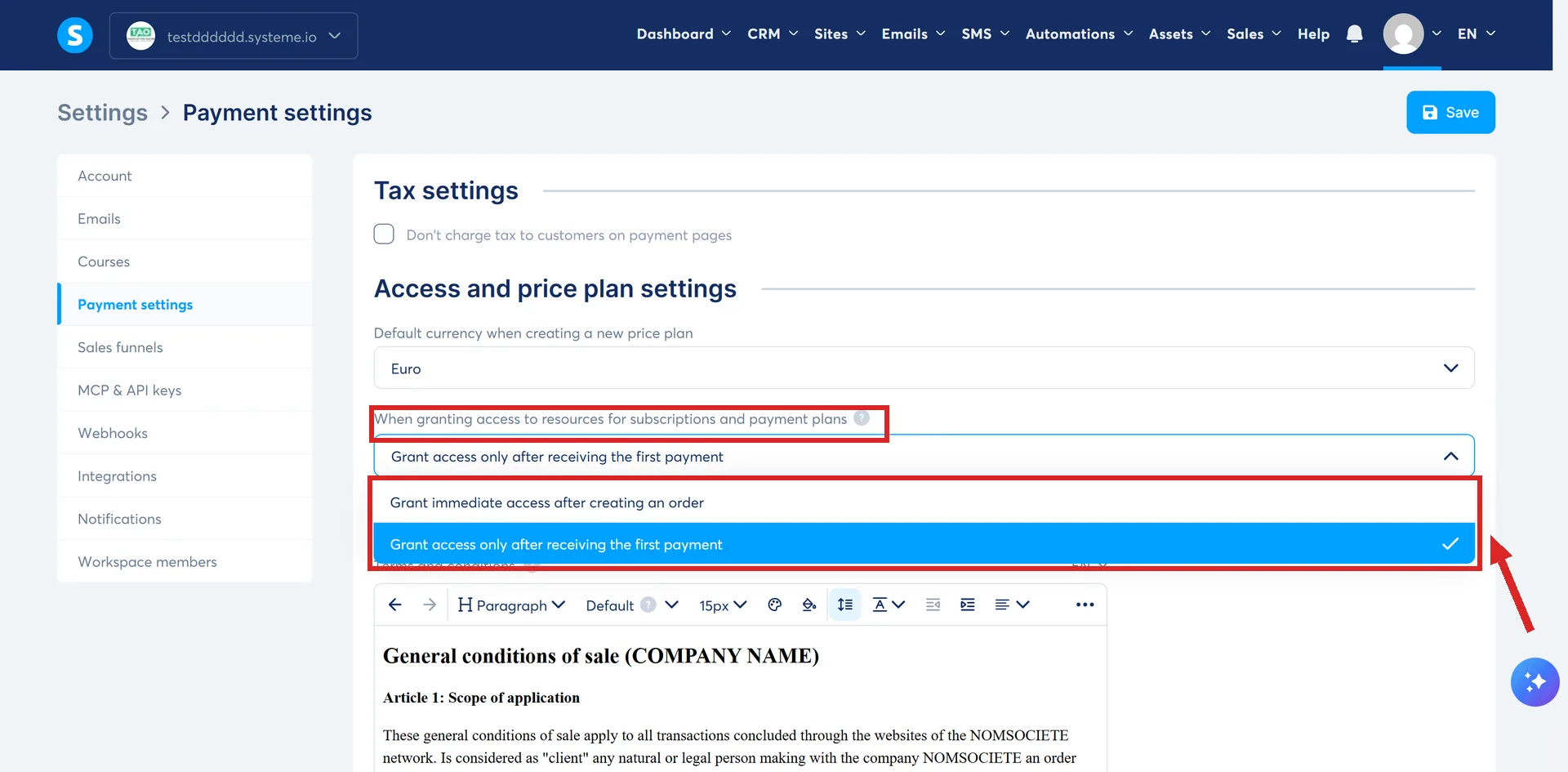
systeme.io's own example of why sellers change it is a seller who could not understand why a customer had course access when the first subscription payment had failed.
There is a cost to switching it. The processing window that motivated the default does not go away, so a customer on a method that takes several days to clear can be left waiting outside a course they have already paid for.
Taking access away yourself
Course access can be removed without touching the billing. Go to Assets, then Courses, open the Students tab, click the student's email address, find the Enrollments section, click the three dots and select Dismiss, then confirm.
That revokes access to the course content only. The person stays on your students list, and removing them from it is a separate action.
What the documentation does not settle
systeme.io's article on failed payments says access is suspended. It does not describe what a suspended student sees when they try to open the course.
How I checked this answer
Nothing on this site is written from memory. These are the sources I checked to write this answer, and the date I checked them.
- A reply from systeme.io support, 4 September 2026, on course access types and failed paymentssysteme.io support
- What happens when a customer's subscription payment failshelp.systeme.io, article 1661
- How do you control access to subscription resources?help.systeme.io, article 2145
- How to manually add students to a coursehelp.systeme.io, article 217
- How to revoke a student's access to a coursehelp.systeme.io, article 274
Checked on
Did this answer your question?
Keep reading
- Can I undo resetting a student's progress? Not from your own dashboard. The 1-month window, and what support needs from you to use it.
- Why can't my students see the lecture I just added? It saved as a draft. The three places that need activating before a student can see anything.
- Block, element, section: what is the difference? Three of these are parts of a page. The fourth is a saved copy of one.